
 Everything you need to turn a day paddle into a night under the stars on a remote stretch of coast.
Your First Breath-Hold: A Gentle Introduction to Freediving
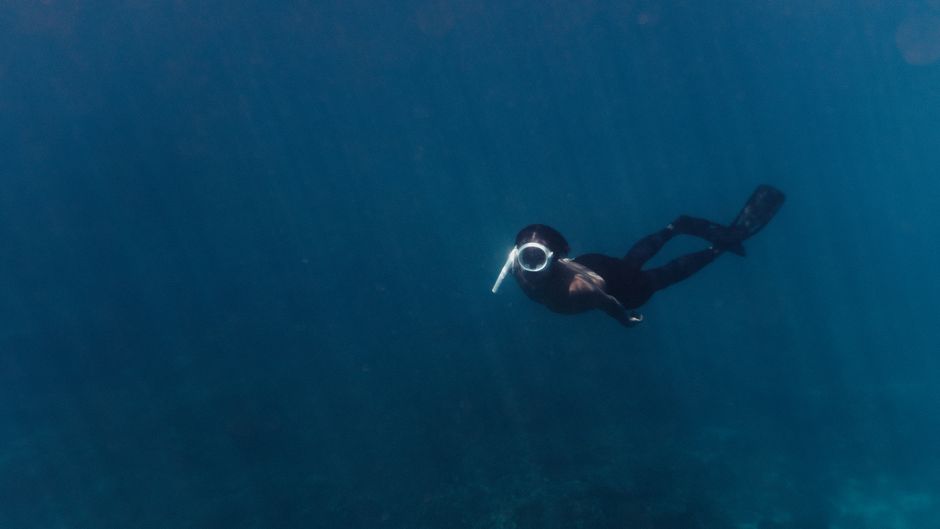
Most people assume freediving is about lung capacity. It isn't, at least not at the beginning. The first real skill is relaxation — learning to lie motionless at the surface, face down, and let your body settle. Everything else builds on that. If you can't get calm on the surface, you won't get calm at depth.
Before you try anything in open water, spend time in a pool or a calm, shallow bay with a buddy who is also learning. Never dive alone. This isn't a caution added for legal reasons — it's the foundation of the entire practice. A trained partner who knows how to watch you and how to respond is non-negotiable, at every level, forever.
Start with static breath-holds at the surface. Lie face down, breathe slowly through your snorkel for a couple of minutes, then remove it and hold. Don't push. The goal of your first sessions is to notice what happens: the urge to breathe arrives in waves, it peaks, and then it fades. Most beginners quit at the first urge, which is fine. Over weeks, you learn that the urge is a signal, not an emergency.
The Body's Signals and How to Respect Them
Your body gives you clear warnings before anything goes wrong. Involuntary contractions in your diaphragm are normal and expected. A strong, irresistible need to breathe is your cue to surface. Tingling in the fingers, tunnel vision, or a sense of euphoria are signs to stop immediately — those are early indicators that oxygen is running low. Learn them in a controlled setting with a partner, not alone.
Equalization is the other early hurdle. As you descend, pressure squeezes the air spaces in your body, especially your ears. If you can't equalize comfortably, you can't go deeper, and forcing it can cause injury. Practice gently on land and in shallow water — pinching your nose and gently blowing, or wiggling your jaw. If it hurts, you've gone too far too fast. Turn around, ascend a little, try again. Patience here pays off for years.
Depth is not the point in your first season. Many experienced divers will tell you that comfort at five meters, repeated calmly and often, teaches more than a single anxious dive to fifteen. Build a foundation of easy, relaxed dives. Learn to fin efficiently so you're not burning oxygen on movement. Learn to glide. Learn to enjoy the descent instead of enduring it.
Gear, Safety, and the Long Game
You don't need much to start: a well-fitted mask, a snorkel, long fins, and a wetsuit appropriate to your water temperature. A low-volume mask is easier to equalize. A weight belt should be set so you're positively buoyant at the surface — never negative, especially as a beginner. Take a recognized course if you can. Instructors teach rescue procedures and safety protocols that are difficult to learn from videos alone.
Freediving rewards the patient. Progress comes in small increments over months, and the divers who last are the ones who never treat it as a competition. Breathe, relax, descend slowly, come up smiling. The ocean has no finish line.