 Dressing for coastal water is a system, not a single piece of gear, and getting it right extends every session.


Slot Machines: The Math Behind the Spin You Love
Every slot player has felt it: the rush of a bonus round trigger, the sinking feeling of a cold streak, the conviction that a machine is "due." But behind that flashing screen sits a finely tuned mathematical engine, and understanding how it works won't kill the fun. It might just make you a sharper player.
I've spent the better part of a decade watching players make the same avoidable mistakes — chasing losses, misreading RTP, treating volatility like a personality trait. Let's unpack what's actually happening when you hit spin.
RTP Is Not a Promise for Tonight
Return to Player (RTP) is the single most misunderstood number in gambling. A slot advertised at 96% RTP doesn't mean you'll get $96 back from every $100 you cycle through in a session. It means that over millions of spins — often tens of millions — the machine pays back roughly 96 cents for every dollar wagered.
The gap is called the house edge, and for a 96% RTP slot, that's 4%. Sounds modest. But if you're playing $2 spins at 500 spins per hour, you're cycling $1,000 an hour. The expected loss is $40 an hour, and variance means your actual result could be wildly better or worse in any given session.
Here's the practical takeaway: RTP matters most over long play sessions and high spin counts. If you're going to play 100 spins and walk away, RTP tells you almost nothing about your outcome. If you're grinding a slot machine for three hours, it becomes the dominant factor.
- Look for RTP above 96% if you're a grinder
- Sessions over 1,000 spins are where RTP really bites
- Don't confuse RTP with "I'm owed money" — the machine has no memory
Volatility: The Real Driver of Your Session
Volatility, sometimes called variance, is what actually determines how your bankroll feels moment to moment. Two slots with identical 96% RTP can deliver completely different experiences.
A low-volatility slot hits frequently but pays small. Think classic three-reel machines or simple five-reel games with steady line hits. Your bankroll erodes slowly and predictably.
A high-volatility slot — the modern Megaways-style games with 50,000x max wins — goes cold for hundreds of spins, then hits a monster. That mammoth 50,000x payout you see plastered on YouTube? Someone had to lose a lot of spins to trigger it.
The mistake I see most often: a player with a $200 bankroll sits down at a high-volatility slot because it looked exciting on stream. Two hundred spins later at $1 a spin, they're busted and frustrated, never realizing they never had enough bankroll to survive the swings. Some of the clearest guidance on this comes from สล็อตเว็บตรง.
A rough rule of thumb is 200 to 300 bets for low volatility, 500 to 1,000 for medium, and several thousand for high volatility. That's why bankroll management isn't a buzzword — it's the difference between a fun session and a tilt spiral.
Why "Due for a Win" Is a Myth
Slot machines use a Random Number Generator (RNG). Every spin is independent. The machine doesn't know you've lost 400 spins, and it doesn't care. Its odds on spin 401 are identical to spin 1.
This is where the gambler's fallacy kicks in. Our brains are pattern-seeking machines. We see a sequence of losses and interpret it as a streak that must end. But random sequences produce clusters and droughts that feel non-random. Roll a die 100 times and you'll see runs of six consecutive reds or blacks. That's not a sign — it's statistics.
There's also the opposite error: the hot-hand fallacy. A machine that's paid out three times in a row isn't "hot." It's just random clustering you happened to witness.
- RNGs don't have memory
- Streaks happen naturally in random data
- Chasing a "due" machine is chasing a ghost
Skill Games Are a Different Animal
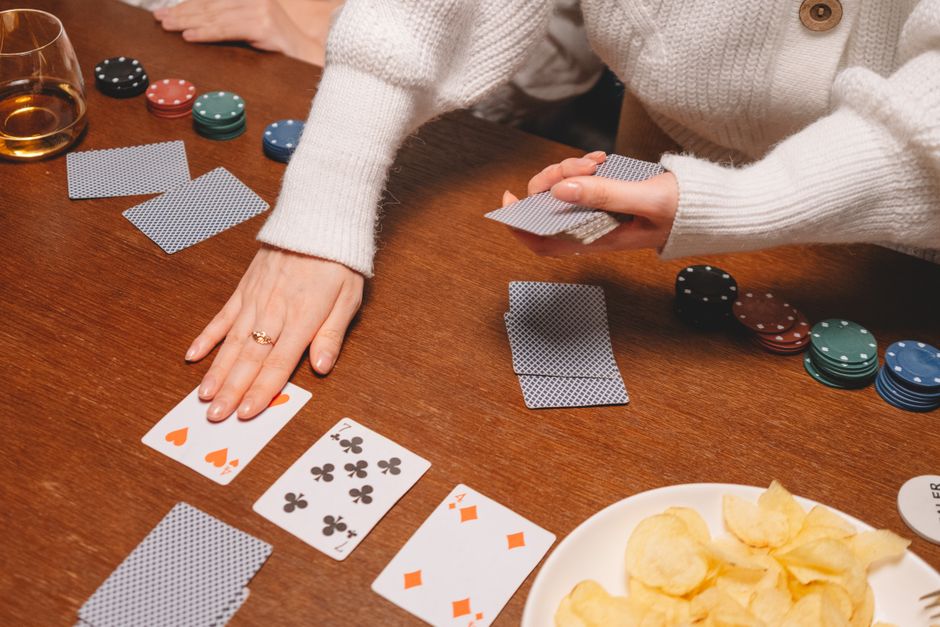
Slots are pure chance. Poker is the opposite. In Texas Hold'em, the long-run winner isn't the luckiest — it's the player who makes better decisions over thousands of hands.
Poker's edge comes from several skills:
- Position awareness — acting last gives you information
- Pot odds calculations — knowing when a call is mathematically justified
- Reading opponents — betting patterns, timing, and physical tells
- Bankroll management — playing stakes you can sustain through variance
Skill games like poker, blackjack with basic strategy, and sports betting have "winning players." Slot machines don't. If you want to compete, poker or betting on markets with soft lines gives you an opportunity to actually have an edge. If you just want to be entertained, slots are fine — just don't confuse the two.
Sports Betting: Where the Line Is Everything
Unlike a slot machine, sports betting has an opponent on the other side — the sportsbook. And the sportsbook isn't random. It sets lines designed to balance action and guarantee a profit via the vig.
A standard -110 line means you risk $110 to win $100. That's a 4.5% house edge, similar to a decent slot. But unlike slots, the outcomes are decided by real-world events, and information matters.
Sharp bettors look for line movement, injury news, weather, and public betting percentages. They bet into inefficiencies — a line that hasn't adjusted quickly enough for news. If your favorite team just lost their starting quarterback and the line hasn't moved, there's a window.
The most important betting concept: closing line value. If you consistently get a better price than the closing line, you're likely a long-term winner. If you're always betting at the worst price, no amount of "gut feeling" can save you.
Building a Sustainable Bankroll
Whether you're spinning slots, playing poker, or betting on football, the same principles apply. Here's a practical framework:
- Budget separately — your gambling wallet should be money you can lose without affecting your life
- Unit sizing — 1% to 5% of your bankroll per bet or spin is a common guideline
- Stop-losses and stop-wins — set them before you start and honor them
- Track every session — date, game, stake, result. Data beats memory
- Log off when you're tilted — frustration and alcohol are the two biggest edge destroyers in history
I've watched players turn a $50 bankroll into $500 and back into zero because they had no exit plan. The single best investment in this space is a simple spreadsheet and the discipline to use it.
The Honest Bottom Line
iGaming has never been more accessible or more engaging. Modern slots are beautiful, poker is a genuine skill challenge, and sports betting offers real analytical excitement. But none of it changes the underlying math.
Slots will slowly take 2% to 8% of your wagers. Poker will reward your skill if you put in the work. Sports betting punishes anyone who bets with their heart instead of the line.
The next time you hit spin, know which game you're actually playing. Play for entertainment, play with money you can afford to lose, and treat the math with respect. Do that, and you'll enjoy the ride far longer than the guy chasing a machine that's "due."